
The specification
| Cost while driving | 0.03 ms | Ryzen 5 3600 / RTX 3050, long sessions, everything switched on |
|---|---|---|
| Cost on foot | 0.00-0.01 ms | Same machine and session, and everything still switched on |
| Frameworks | 3, plus standalone | Qbox, QBCore and ESX, detected at start-up. Standalone works too |
| Resources read by name | 28 | Fuel, inventory, notifications, voice, phone, banking: Roll Call |
| Languages | 5 | English, Portuguese, Spanish, French, German. Yours takes one file |
| Currency formats | 12 | Symbol, separator and side per country: $3,034, 3.034 €, 403 034 ₽ |
| Dependencies | 2 | ox_lib and oxmysql, both free and open source |
| OneSync state | ON | Must be enabled. What else it needs is on Before you buy |
| Minimum game build | 3258 | Electric vehicles only; everything else runs on older builds |
| Delivery | Cfx.re asset escrow | In the portal of the account you paid with, as payment clears |
| What stays editable | config/ | Asset escrow encrypts everything outside it |
One menu, dressed by the server
The owner picks an accent, a background and a zone colour, and the panel recalculates its own dividers, surfaces and contrast around them. These five are the same menu, on the same tab, in five servers.
The whole screen, and your players set it
Statuses, the info row, the dashboards, the minimap, the crosshair, the weapon: every widget a server puts on screen is in this one resource, and none of it waits on a second script. Which leaves the part that actually costs you time. "Can you move the speedometer?" "The stress bar is covering my chat." Right now every one of those is a file edit, a restart, and a player waiting on you.
Hand them /hud instead. They drag widgets where they want them, with snap guides and centring lines, pick the style, choose the colours, and it all comes back on reconnect exactly as they left it. Three presets each, so the player who races on a bare screen and roleplays on a full one never has to pick a side.
The ones that ship, and how they warn
Health, armour, hunger, thirst, stamina, stress, oxygen, voice, ammo and the player id, in five shapes, any colour, anywhere on screen. Four of them glow when they run low, and the glow beats faster the closer to zero they get, so a player catches it without reading a number.
Voice changes with the channel: a microphone while talking, a walkie-talkie with the frequency underneath on radio, a handset on a call. Hide inactive status takes an idle icon off screen and brings it back the instant it matters.
A crosshair players bring with them
Seven shapes, colour, outline, centre dot, and rules for when it shows: always or only when aiming, optionally hidden in vehicles or behind a scope.
Crosshairs export as codes, and this one goes further. Swap the CROSS- prefix for CSGO- and the code opens in Counter-Strike 2; a CS2 code pastes straight in. Whole designs travel the same way, as AURORA- codes that arrive intact on any other server running Aurora HUD.
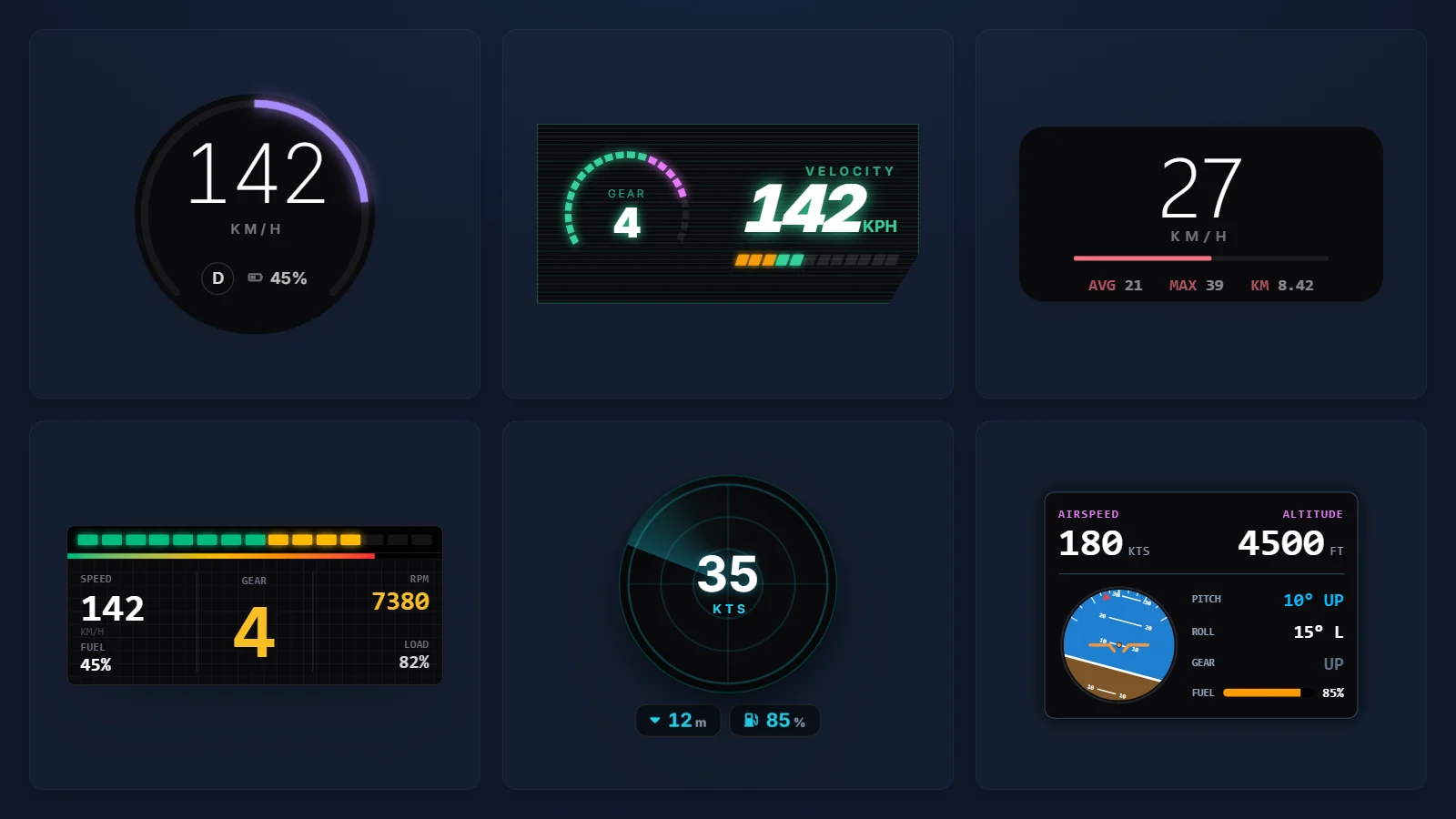
Speedometers that know what you are driving
Speed, gear, RPM, fuel, engine health, lights and belt throughout. Aircraft add altitude, pitch, roll and an artificial horizon. Bicycles drop what a pedal bike does not have and answer what a cyclist asks instead: distance, average, and the fastest you went.
Electric vehicles swap RPM for a power gauge and show the battery recovering under braking. Every style previews from the menu without getting into a vehicle.
- Land: cars, motorcycles, quads
- analog · minimalist · sim-racing · futuristic
- Bicycles
- cyclocomputer · minimal
- Boats and submarines
- sonar · nautical
- Aircraft
- fighter · civilian
Your server's statuses, not just ours
Radiation. Infection. Hypothermia. Whatever your server actually runs on gets an icon, a colour and either an on/off state or a 0–100 bar that behaves exactly like health does, fed straight from your script.
It reads from wherever the value already lives: an export, an event, a statebag, or a push when your script would rather tell the HUD than be asked. The icon comes from the whole Font Awesome library, and a static one acts as an on/off light instead of a bar.
Your players read it in their own language
English, Portuguese, Spanish, French and German. The choice is personal: one player reads the menu in French while the next reads it in German, on your server, at the same time. You set the default and they can follow it or override it.
Money is the other half of that. Twelve currencies, each with the symbol, thousands separator and side the country actually writes it on: $3,034, 3.034 €, 403 034 ₽. You pick one, and it applies everywhere the HUD shows money.
Your branding, at no extra cost
Point the menu at your logo, then set its background, accent colour and opacity to match your server. Every menu screen your players open carries your identity, not ours.
Aurora's branding comes off in the admin tab, in seconds, included in the price. There is no white-label upsell here.
When a script beside it goes quiet
Fuel, notifications, voice, phone, banking and inventory: twenty-eight resources recognised by name, from ox and pma-voice to okok, brutal, wasabi, mythic, qs, jaksam, tgiann and both ak47 inventories. Qbox, QBCore and ESX are detected at start-up, and so is running no framework at all.
That record is Roll Call, in the Support tab: what the HUD found against what is really running. Using something not on the list? A fuel script is a name and one function, and the integration guide shows you where to put it.
Built for the person who has to run it
Admin controls sit behind their own ace, aurora_hud.admin, and they are marked red throughout the menu. Handing a moderator their powers does not hand them the power to redesign every player's screen.
When something goes wrong, the Support tab copies a full diagnostic report in one click: framework and integrations found, every error since start-up. Paste it into a ticket on the Aurora Discord and most of the time it says what is wrong before I have read it.
Underneath, every integration runs inside a guard. A missing export or a renamed resource does not take the HUD down with it. It keeps running, and Roll Call tells you exactly what failed.
Also in the box
- Minimap and postals
- Circular or square, with zoom, tilt and a coloured border. Postal codes read from nearest-postal.
- Weapon
- Name, magazine, reserve ammo and durability, counted through your inventory.
- Player info
- Job, wallet, bank, ID, clock and weather, as a row the player can recolour and trim.
- Cinematic mode
- Black bars on a keybind, native HUD suppressed, radar kept or hidden.
- Stress, optional
- Configurable triggers, screen effects and relief items. Off until you want it.
- Vehicle controls
- Seatbelt, indicators, hazards and cruise control built in. Or switch ours off and feed the icons through exports.
What it takes over, and what it will not do
- The minimap
- Replacement round and square masks, and control of when the radar shows. Another resource streaming minimap files will fight it.
- The native HUD, in cinematic mode
- Nothing else is suppressed permanently, so an existing HUD resource draws on top of this one. Stop it.
- Outside the three frameworks
- On a standalone server the job, wallet, hunger and thirst widgets stay dark until another script feeds them.
- The code itself
- Asset escrow encrypts everything outside config/. What stays open is listed on Before you buy.
What you get
- Delivery is automatic: the moment payment clears, the licence lands in the Cfx.re portal of the account you signed in with, through asset escrow. Later versions arrive in the same place, and the changelog says what is in each one.
- I answer on the Aurora Discord myself: the resource, its settings and its exports. Type /claim after buying and the customer role is yours.
- One payment, no subscription.
- The full documentation is public before you buy. What it costs to run, what it needs and what you can edit is one page.